What 256 Product Managers Told Reddit About Their Salaries


In early 2024, product managers on Reddit posted detailed information about their salaries, titles, years of experience, company types, and locations. 256 people responded. The dataset is self-reported and Reddit-skewed, so it over-represents tech and high cost-of-living markets. Still, the patterns are worth looking at.
Geography does more work than most people expect
Of the 256 responses, only 10 reported total compensation below $100,000. That sounds high until you look at where most respondents were located. California and New York dominated the dataset, and both markets pay significantly more than everywhere else.
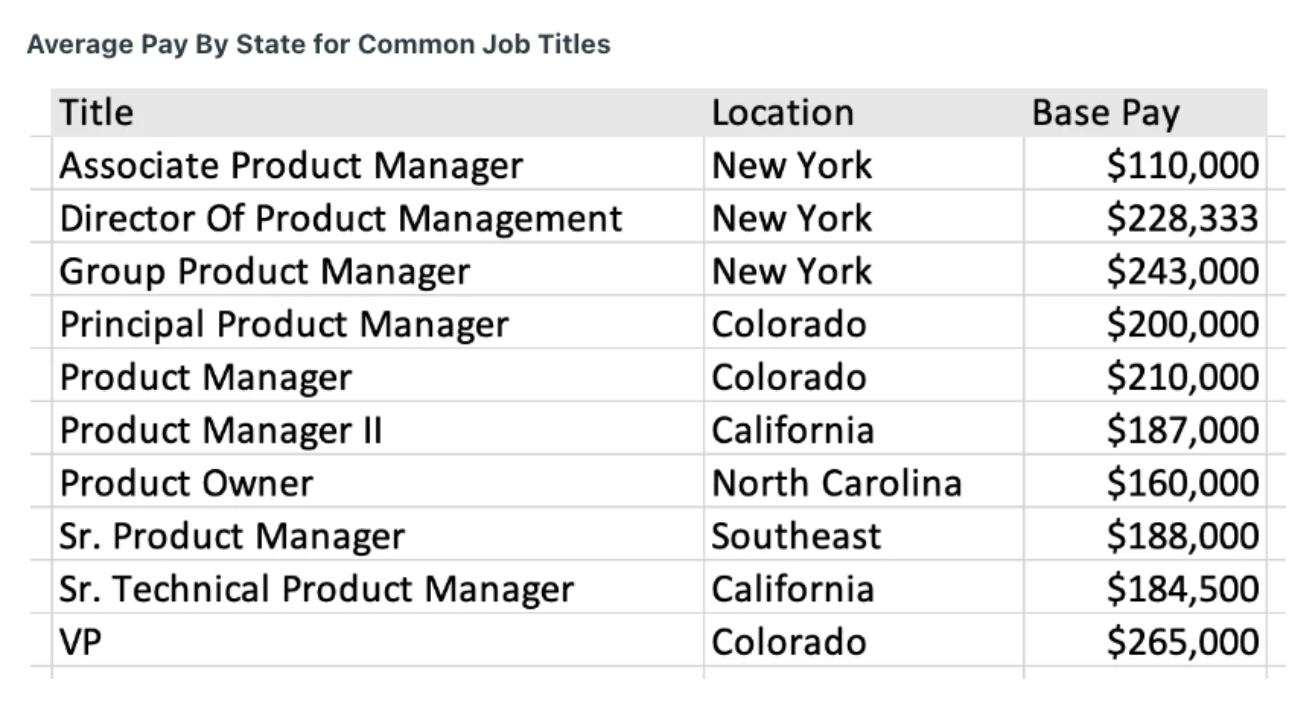
This isn't just a cost-of-living adjustment. It reflects where the jobs are concentrated and which companies are competing for talent. A PM with five years of experience in a mid-sized city and the same PM at a San Francisco tech company are not operating in the same market, even if their responsibilities look similar on paper.
Interestingly, even some early-career PMs with around 1–3 years of experience in tech-heavy locations like California and New York reported salaries in the $150,000 to $200,000 range. Tech hubs reward PMs highly regardless of experience level.
If you're early in your career and weighing geography as a variable, the data suggests it's one of the biggest levers you have.
Experience matters more than credentials
Educational backgrounds in the survey ranged from MBAs to coding bootcamp certifications, with degrees in business, economics, computer science, biology, literature, and theater arts all represented. There's no clear cluster around a particular path.
What does cluster is the relationship between experience and pay. PMs with 5 to 10 years of experience generally reported compensation between $100,000 and $200,000. Those with 15 or more years, especially in leadership roles, regularly crossed $250,000, with some reaching $600,000 or higher.
For anyone deciding whether to spend time and money on an MBA: the data doesn't show a strong signal for it. Experience in the role compounds in ways that credentials don't.
Startups vs. public companies: a real tradeoff
The survey shows a clear split between how startups and public companies structure compensation.
Public companies tend to offer stable base salaries with smaller, consistent bonuses. Senior PMs at larger companies reported salaries generally peaking between $150,000 and $300,000, with predictable bonus structures of 10 to 25 percent of base.
Startups often pay lower base salaries but include substantial equity. One California startup PM in the survey reported a $180,000 base with $400,000 in equity over four years, for a total package of $580,000. That's the upside case. The downside case is the equity never vests at meaningful value, and you worked longer hours to get there.
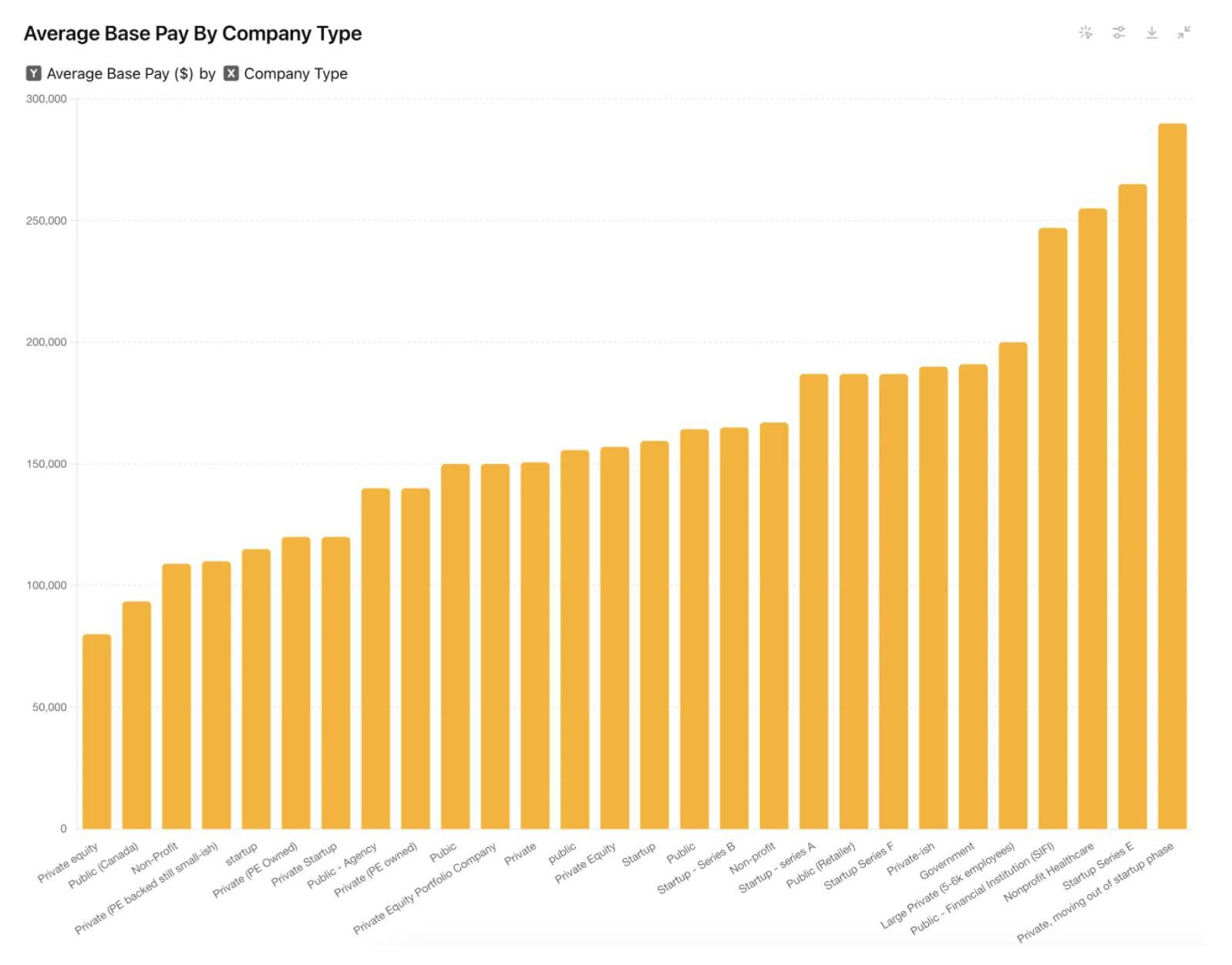
The tradeoff is straightforward but worth naming clearly: startups offer higher potential upside and higher risk, with more stress baked in. Public companies offer predictability and better work-life balance, with a ceiling that's lower but a floor that's more reliable.
Senior PMs also reported annual bonuses ranging from 10–25% of base, and some managers reported annual equity grants exceeding $300,000. Performance-based bonuses were particularly common at private equity-owned firms and startups, where overall company success heavily influenced annual packages.
The Staff PM anomaly
One finding that stands out: Staff Product Managers reported higher total compensation than Directors of Product Management in several cases, with some packages exceeding $500,000.
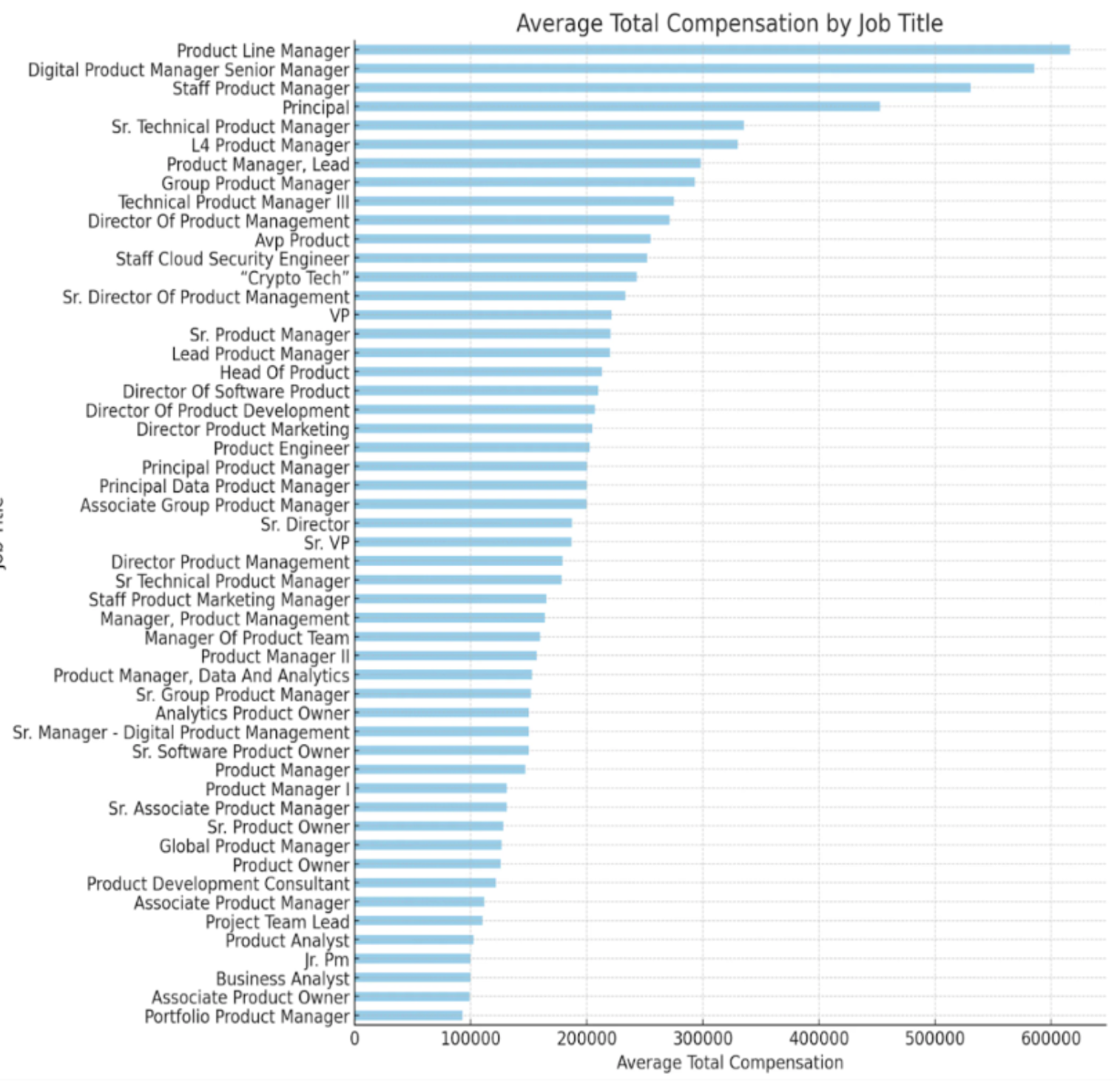
This is counterintuitive to people outside tech, where "Director" sounds like a clear step above "Staff." In practice, the Staff PM title at large tech companies is an individual contributor role for very senior PMs who are not moving into management. Companies pay well to retain that level of expertise without requiring the person to manage a team.
Directors tend to make more in total headcount responsibility and organizational scope, but the highest-compensated individual contributors can out-earn them on paper.
If you're a senior PM deciding whether to move into management, this is worth factoring in. The management track is not automatically the higher-paying one.
Job satisfaction and work-life balance
Several PMs commented on work-life balance, noting that public and non-profit sector positions tended to offer better balance than the private sector. Many senior PMs in tech, especially in California and New York, mentioned long working hours but balanced that with high compensation packages.
PMs at startups receiving large equity grants often acknowledged the trade-off: high compensation for high stress and potentially long working hours.
What the data actually tells you
The clearest signals from this dataset:
Location is the biggest single variable in early compensation. Experience is the biggest variable over time. Education has almost no measurable effect once you're in the role. Company type determines risk profile more than it determines which path pays more in the long run.
The 256 people who responded to this survey are not a representative sample of all product managers. But the patterns they show are consistent with what broader compensation research finds. Geography, experience, and company stage explain most of the variance. Almost everything else is noise.